
Architecture note#
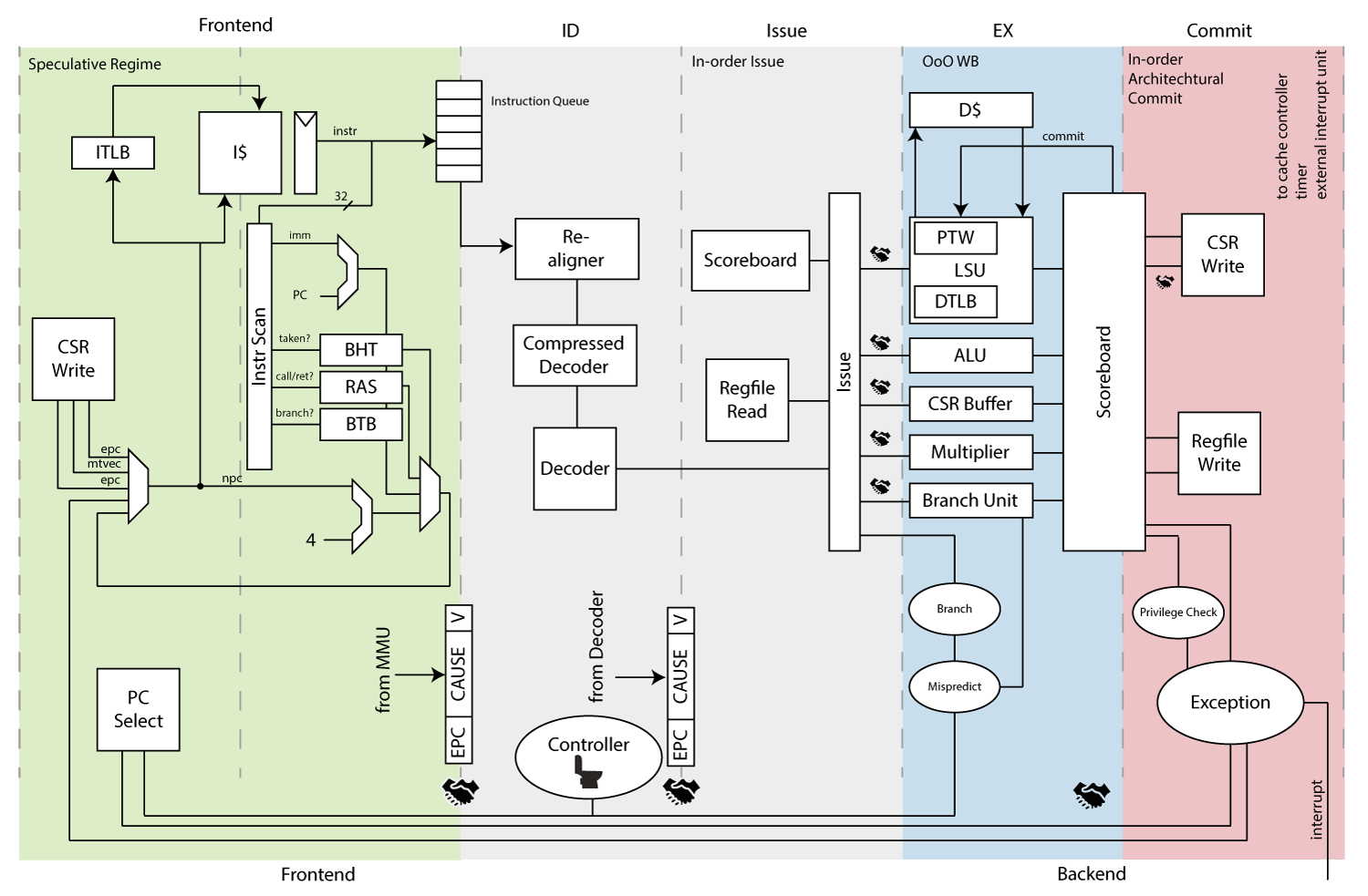
PC gen stage#
- The fetching address for i-cache is always word-aligned.
Fetch stage#
Its fetch stage doesn’t have much decoding work to do, only the necessary one to generate next PC. And it relies on its branch prediction to give out next PC.
There is an internal FIFO with 2 entries to log the PC (and other meta-info) that was sent to i-cache, while waiting for its response.
- JW: This method can decouple the delay of i-cache.
There is a sync FIFO on the output boundary of fetch stage to decouple front-end and back-end.
- JW: the scheduler pop from this FIFO when there is available resource for the next instruction. And potentially it can be easily changed to dual-issue by changing the read mechanism of this FIFO.
Decode stage#
- It puts the RVC decoding in the decode stage.
- JW: this is better than what we had in ORV, in which I put the RVC decoding and realignment in IF stage, and made the critical path more critical than ever. That’s a bad decision to be honest. I was given too little time to think about this timing problem when I was adding RVC support.
- The decoded info from this stage is very limited. It always seems like this stage is for RVC decoding only.
- JW: It could be potentially merged with issue stage. I don’t quite understand their design consideration here.
Issue stage#
- It waits for branches to be solved then issue predicted instructions into execution. It’s definitely OK because all the branch instructions in RISC-V only needs 1-cycle to resolve in ALU, so it won’t be any kind of performance loss.
Execution stage#
- Load operations are issued/executed right away because there is no side effect. Need to check the store buffer first in order to get the most updated data.
- Store operations are put into store buffer first, after going through MMU, to wait for commit. Multi-issue architecture makes store operations can be killed, therefore it cannot be write into D-Cache when issued.
- Speculative buffer: used to store the non-committed instructions that could be potentially killed later
- Commit buffer: move the entry from speculative buffer into commit buffer as soon as it’s committed at the commit stage
- Both buffers are working on physical address
- CSR buffer: in this multi-issue architecture, CSR operations could also be killed by its previous exceptions. So it has to go into a buffer/queue. And also this buffer off-load some info from the main scoreboard.
Commit stage#
- Golden rule: no other pipeline stage is allowed to update the architecture state under any circumstances.
- The architecture states includes register file, CSR, memory (D-Cache in this case)
- This stage also handles exceptions and interrupts, as well as stall
- JW: ORV uses the same stall strategy, propagating stall backwards from commit stage. After squeeze out all the bubbles, the pipeline will eventually stop.
Plans#
After reading through the architecture documents, I’m more and more curious about its implementation. I’ll have to say that it really makes me rethink about my own design a lot. So my plan is to read through the whole project to learn from them.
Several good points of their project
- Support Verilator
- Use Travis CI