
RISC-V SPEC#
https://riscv.org/specifications (official version v1.10)
https://github.com/riscv/riscv-isa-manual (source code)
User-level ISA (unpriviledged)#
- All the basic instructions, and extensions
- Memory model
Priviledged ISA#
- Priviledge level: M (machine), H (hypervisor), S (supervisor), U (user)
- CSR (control status register)
- Virtual-memory system
Debug & Trace#
First impression: ISA subsets#
RISC-V is a family of ISAs#
Divided into several subsets: I, M, A, F, D, C, …
Domain-specific architecture (by David Patterson)
- The ending of Moore’s Law => domain-specific architecture is the future of computing
- Too costy to be “general purpose” anymore
- Too many new domains
- Not enough transistors or power to be general purpose
- E.g. TPU-like xPU for AI computing
RISC-V ISA’s approach
- Different domain-specific implementations can select subsets suitable for its own domain
- Only I (base) is mandatory
- Can be extensible in the future
Ref: A Domain-Specific Architecture for Deep Neural Networks
First impression: ISA subsets#
My deepest impression of RISC-V ISA
- Extensible
- Hardware-friendly
Why RISC-V ISA is highly extensible?#
Instruction space is divided into 3 disjoint categories
- Standard: defined with specification
- Reserved: for future extensions
- Custom: implementation can have its own custom instructions
Standard subsets as of now
I: base integer computational instructions, integer load/store, control-flowM: integer multiplication and division extensionA: atomic instruction extension, for inter-process synchronizationF/D: single/double-precision floating-point extensionC: 16-bit compressed instruction extension (higher code density)
IMAFD=G, soRV64GC=RV64IMAFDC
RISC-V’s approach of extension#
Extension#
Keep the base the same, while add new extensions over time
Reserved#
Add extension very carefully, sometimes seems too slow
Custom#
Keep custom instruction category open, and the software flow to add custom instruction easy
32-bit or 64-bit?#
Exclusive 32-bit and 64-bit ISA#
- Explicitly separate 32-bit and 64-bit ISA
- Unlike ARMv8-A which has AArch32 and AArch64 both compatible
- For hardware simplicity
- Optimize for its needs without requiring to support all the operations needed for other base ISA
- But introduced some confusion
- In 32-bit version,
ADDmeans 32-bit add, but in 64-bit the same instruction means 64-bit add - And 64-bit version has
ADDWthat support 32-bit operations
- In 32-bit version,
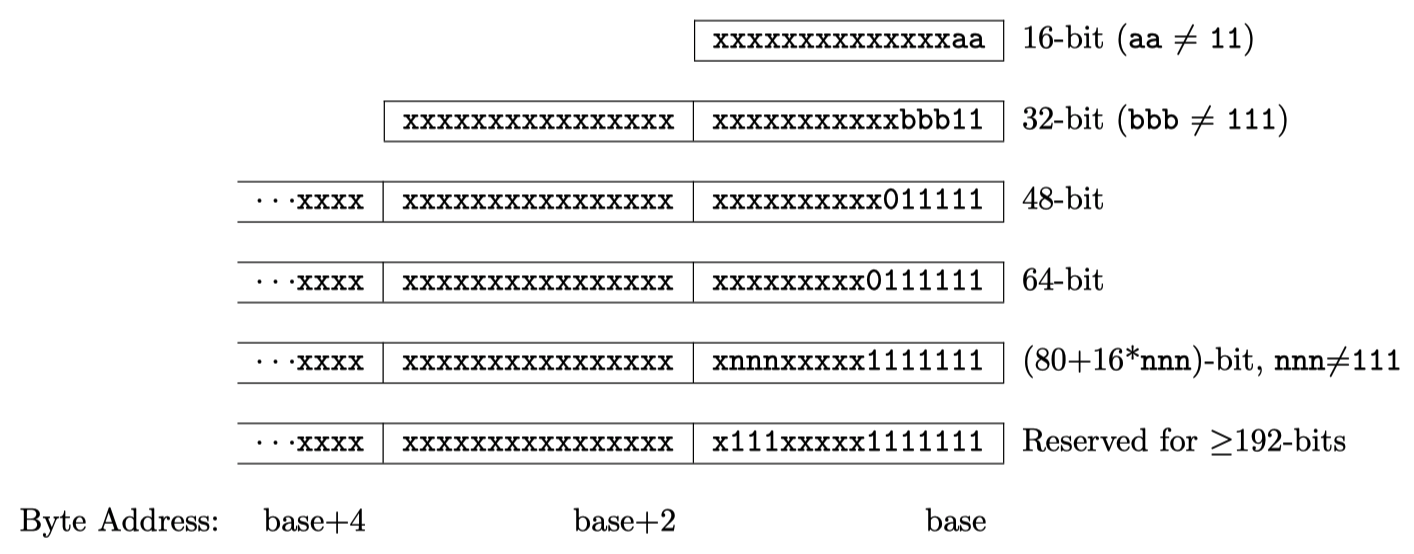
Instruction length is orthogonal#
- 32-bit for normal instructions
- 16-bit for compressed extension
- 48-bit or even longer reserved for future
RISC-V Terminology#
Hart = hardware thread#
Hart is a very important concept in RISC-V
- One RISC-V core might contain multiple harts (hardware threads) to support multithreading
- All ISA concepts are based on hart
- Each hart has its own PC, GPR, CSR, interrupt, exception, and etc.
- But they may share the same front-end (instruction fetch and decoding), or shared ALU, LSU or accelerators
RISC-V Terminology#
Memory#
Size unit
- Word = 32-bit
- Halfword = 16-bit
- Doubleword = 64-bit
- Quadword = 128-bit
Implicit and explicit access
- Implicit memory access = instruction fetch
- Explicit memory access = load/store
- Memory access ordering between implicit and explicit access:
FENCE.I- E.g. self-modified code
Weak Memory Ordering (RVWMO)
- This is the weakest model allowed
- Implementation can adopt stronger model of Total Store Ordering
Little-endian
- Hardware-friendly
- Fixed, not configurable like MIPS
RISC-V Terminology#
Exceptions, traps and interrupts#
- Exception: unusual conditions happened in current RISC-V hart
- E.g. illegal instructions, divide by zero, page fault
- Precise exception
- All instruction before the exception has to commit
- All instruction after the exception cannot commit
- Interrupt: external asynchronous event asking for RISC-V hart’s attention
- E.g. DMA is done, keyboard input
- Interrupt doesn’t need to be precise
- Trap: the transfer of control to a trap handler caused by exception or interrupt
- Contained trap: to higher privilege mode, e.g.
ECALL - Requested trap: the same privilege mode, e.g. system call
- Invisible trap: transparent to software, e.g. page fault
- Fatal trap: fatal failure, and causes the execution terminate, e.g. watchdog timer timeout
- Contained trap: to higher privilege mode, e.g.
[Tips] How to download and compile latest ISA SPEC#
git clone https://github.com/riscv/riscv-isa-manual.git
cd riscv-isa-manual

git tag -l
git checkout draft-20190521-21c6a14 # select the latest tag
make
Pre-requisition: install LaTeX in Ubuntu#
apt-get install texlive-fullRV32I: base integer instruction set#
Let’s start from the base, and talk about extensions later.#
RV32I / GPR (general purpose registers)#
- 32 GPR: x0 to x31
- X0 is hardwared to 0
- Very useful
NOPis implemented asADDI x0, x0, 0
- Very useful
- GPR + PC = architectural state
- Width: depends on 32-bit or 64-bit system
XLENrepresents data width- E.g. 32-bit system
XLEN=32
- E.g. 32-bit system
Correspondingly, ILEN represents instruction width. Currently, only ILEN=32 and ILEN=16 are defined.
RV32I / instruction formats#
ILEN = 32instruction width = 32-bit- 4 base formats + 2 immediate-encoding variants
- Very hardware friendly
- Register specifier always in the same place
opcodeare always in the same place- Also considered instruction frequency (more common, simpler opcode)
funct3/funct7are in the same place- Immediate is encoded considering hardware muxing overhead
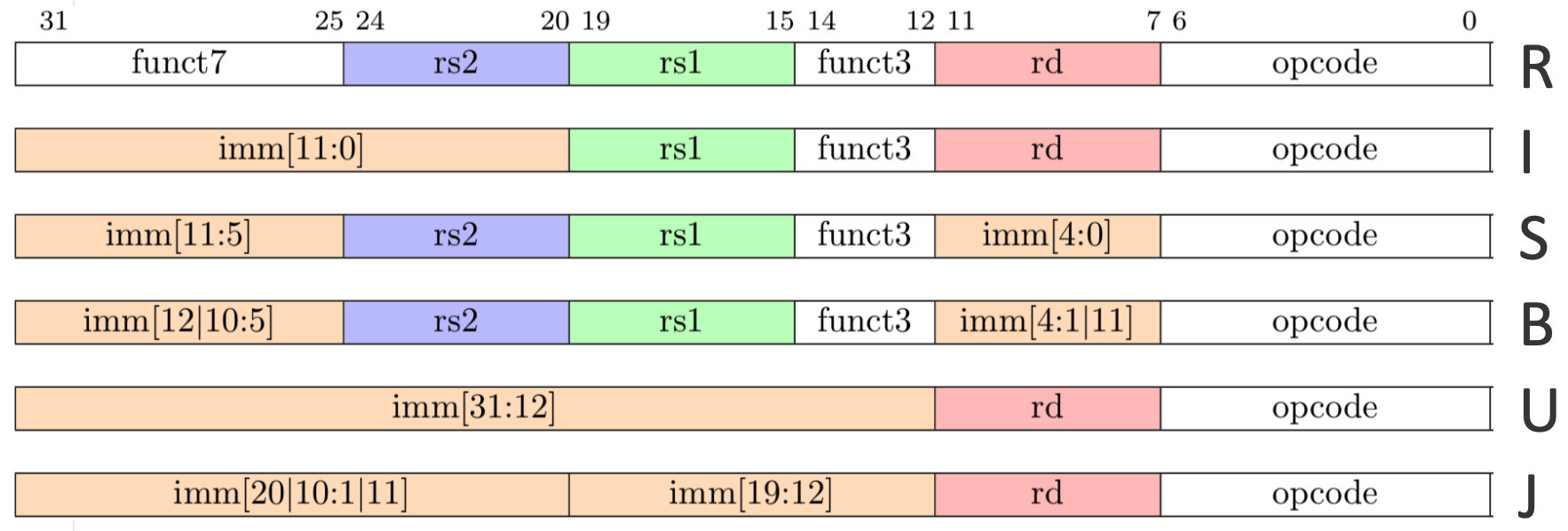
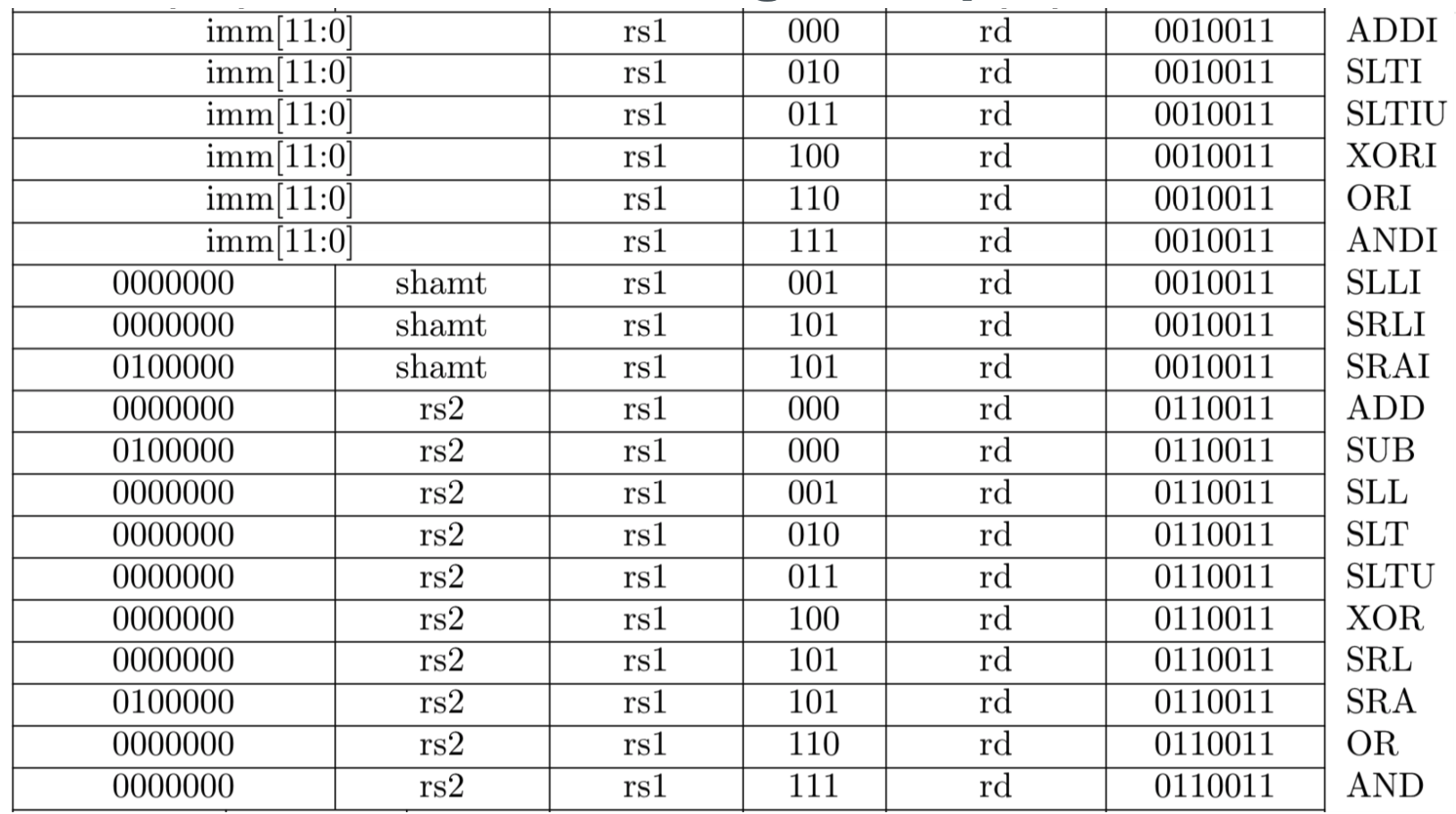
RV32I / arithmetic and logical operations#
- Add, sub, and, or, shift, comparison
- No conditional operation, no implicit flag registers
- Comparison always write to
rd, next instruction check its value and decide what do next - Worse code density, but much easier hardware design
- Comparison always write to
RV32I / memory access instruction#
Load:
rd := @(rs1 + imm)Store:
@(rs1 + imm) := rs2Sign extension when load
- By default, extend sign bit to
XLEN U(unsigned), so do zero-extend
- By default, extend sign bit to
Byte selection
B= byte = 8-bitH= halfword = 16-bitW= word = 32-bitD= double-word = 64-bit
RV32I / memory access instruction#
Misalignment#
- E.g. if
LDdoesn’t align to 64-bit boundary, it’s a misalignment - Whether misalignment will trigger an exception, it depends on the implementation
- To simplify hardware design
- Also support special application, like SIMD
RV32I / addressing#
- Absolute address:
LUI(load upper immediate)
lui     t0, 0x12345     # t0 = 0x12345000
lw t0, 0x678(t0) # t0 = MEM_READ(0x12345678)- PC-relative address:
AUIPC(add upper immediate to PC)
auipc   t0, 0x12345     # t0 = PC + 0x12345000
lw      t0, 0x678(t0)   # t0 = MEM_READ(0x12345678)
Most of the time we use
AUIPCbecause the program should be able to load to any address base, and addressing inside is relative toPC.
RV32I / jump (unconditional)#
JAL(jump and link): use immediate number as jump offset (+/1 1MiB)rd := PC + 4; PC := PC + imm- Function call:
rd = x1 = ra
JALR(jump and link register): use register and immediate number as jump target addressrd := PC + 4; PC := rs1 + imm- Return from a function call:
rd = x0, rs1 = x1 - Indirect call:
rd = x1 = rato further away address

RV32I / branch (conditional)#
- Compare
rs1andrs2- if true,
PC := PC + imm - else
PC := PC + 4
- if true,
EQ: equal;NE: non-equalLT: less than;GE: greater thanU: unsigned comparison

RV32I / fence#
FENCE: for memory ordering- Guarantee all memory access before this instruction has already been committed to its destination.
- E.g. write data structure to external DRAM, then notify PCI-Express DMA to send it out through its link
- Guarantee all memory access before this instruction has already been committed to its destination.
FENCE.I: for self-modifying code- Force all memory write to commit first, then invalidate all the I-Cache entries, before resume instruction fetch.
- Will be discussed in later session regarding to “Memory Model”

RV32I / CSR access#
CSRRW: read/write CSR, exchangers1andrdCSRRS: read then set bits, users1as bit mask, old value written intordCSRRC: read then clear bits, users1as bit mask, old value written in tordCSRRWI/CSRRSI/CSRRCI: meaning are the same, just use immediate as bit mask- Notice: all CSR access instruction is atomic instruction, which means it will happen in one cycle

RV32I / system call and breakpoints#
ECALL: trap into system call in higher privilege mode, raise environment call exception- Normally the arguments are passed with memory, pointer is saved in
mscratchregister
- Normally the arguments are passed with memory, pointer is saved in
EBREAKPOINT: trap into debug mode, raise breakpoint exceptionMore details in later session regarding to “system call” and “debug mode”

That’s it!#
RV32I is a complete instruction set#
Variants#
Data width variants#
- RV64I: 64-bit data/address variant
XLEN = 64general purpose registersD(double-word) load/store- E.g.
LD a0, 0(sp)
- E.g.
W(word) arithmetic instructions that works on lower 32-bit of the registers- E.g.
ADDIW a1, a0, 1
- E.g.
- RV128I: 128-bit data/address variant
Because they are exclusive instruction sets, need to change compiler
Variants#
Instruction length variants (as ISA extension)#
- RV32C (compressed): 16-bit instruction extension
- Future: SIMD, …
Variants#
ISA extensions#
M: integer multiplication and divisionA: atomic instructionF: single-precision floating-pointD: double-precision floating-pointC: compressed instruction
These are the most used ISA extensions. IMAFD = G
Other popular working-in-progress extensions
N: user-level interruptsV: vector operationsP: packed-SIMD instructions- …
RV32M: multiply & divide#
| Instruction | Meaning |
|---|---|
mul | Multiplication, store low 32-bit to rd |
mulh | Signed multiplication, store high 32-bit to rd |
mulhu | Unsigned multiplication, store high 32-bit to rd |
mulhsu | Signed x unsigned, store high 32-bit to rd |
div / divu | rd = rs1 / rs2 |
rem / remu | rd = rs1 % rs2 |
- Separate instruction to get higher and lower parts of multiplication result. But if do
mulh*followed bymuldirectly, hardware does not need to redo the multiplication again. - The same thing applies to division results also.
RV32A: atomic memory operation#
- Atomic memory operation = read-modify-write
- In RISC-V, it support 2 types of atomic operation model
- Read-modify-write instruction
- Load-reserve / store-conditional
AMO (read-modify-write)#
- Directly send
amo*instructions down to the memory hierarchy- Easy and intuitive
- Needs both network fabric and target memory hierarchy support atomic memory operation
- Cannot do too complicated operations
LR/SC (load-reserve / store-conditional)#
- Split read-modify-write into 3 steps
- Load data and acquire reservation on target address
- Compute new value
- Store new value, only if reservation still held
- Store may fail, when reservation is not acquired or not kept, so it will need retry
- Example: use LR/SC to decrement a variable until it’s zero
retry:
  lr.w t0, (a0)
  beqz t0, done
  addi t0, t0, -1
  sc.w t1, t0, (a0)
  bnez t1, retry
done:- Pros: easy to implement, can support complicated operations; cons: low performance
RV32E: embedded extension#
- Reduce 32 GPRs to 16 GPRs
- For a super small implementation, 32 GPRs can take up 25% area
Rarely see any implementaions
Floating-point extensions#
F/DextensionsF= single-precision floating-pointD= double-precision floating-point
- Floating-point specific registers: f0 - f15
- If only support F, register width is 32-bit.
FLEN = 32 - If support both F & D, all registers are 64-bit.
FLEN = 64
- If only support F, register width is 32-bit.
- Floating-point CSR:
fcsr = {frm, fflags}- Rounding mode register (dynamic)
- Aggregated exception flags
Floating-point / load & store instructions#
- Same instruction format as integer load/store
| Instruction | Meaning |
|---|---|
flw frd, imm(rs1) & fld frd, imm(rs1) | Load single/double-precision floating-point from address imm(rs1) into frd |
fsw frs2, imm(rs1) & fsd frs2, imm(rs1) | Store single/double-precision floating-point from frs2to address imm(rs1) |
f* = float-poing register, e.g. frd is floating-point destination register
Floating-point / conversion instructions#
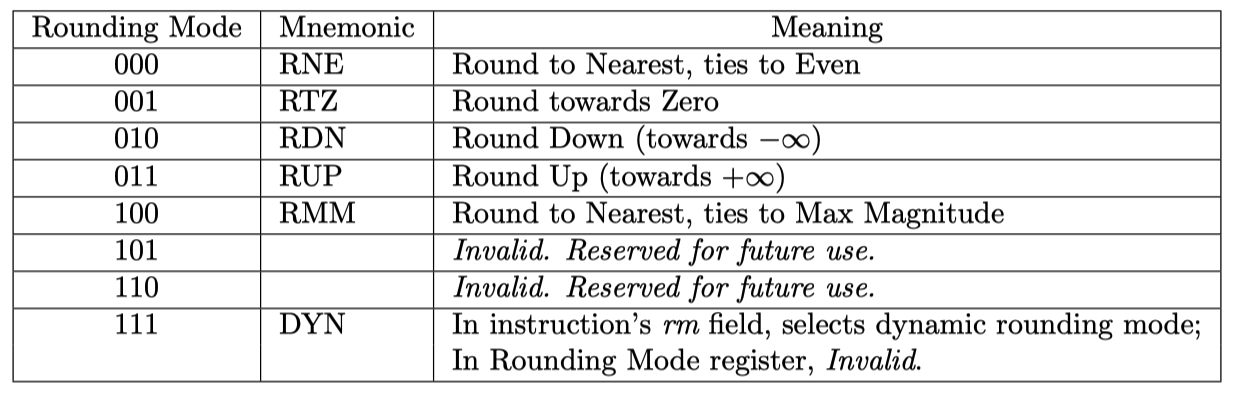
- Rounding mode
- Static rounding mode: defined in instruction
RMfield - Dynamic rounding mode: instruction
RMfield isDYNthen usefrm(rounding mode register)
- Static rounding mode: defined in instruction
- Instructions
FCVT.*.*: convert between floating-point registers and GPR (as integer value)FMV.*.*: directly move between floating-point registers and GPRFSGNJ: sign-injection provides ABS and NEG operation on floating-point
Floating-point / arithmetic instructions#
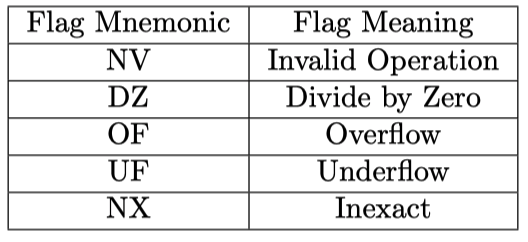
- Floating-point exception
- Will no generate trap on IEEE-754 exceptions. Need to read
fflagsfields infcsr - No NaN-payload propagation (NaN = not a number)
- Exception flag in
fcsr
- Will no generate trap on IEEE-754 exceptions. Need to read
Floating-point / arithmetic instructions#
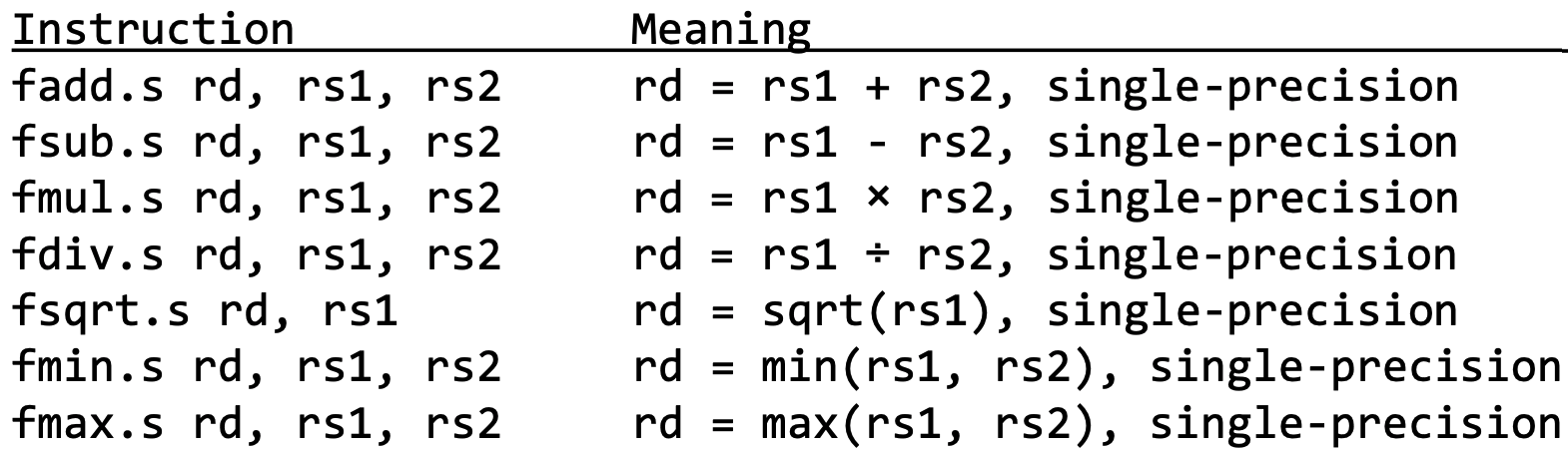
- Floating-point arithmetic operation examples
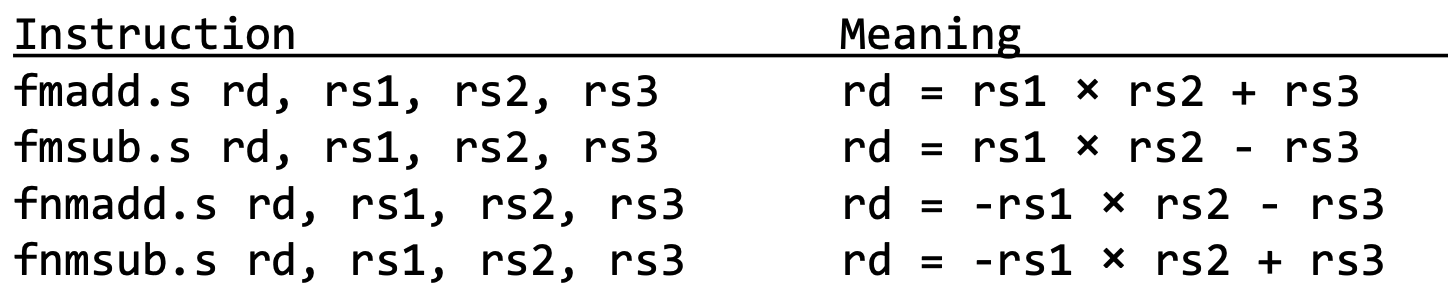
- MAC: multiplication and accumulation (in GCC, it’s called FMA, fused multiplication/addition)
Floating-point / classification instructions#
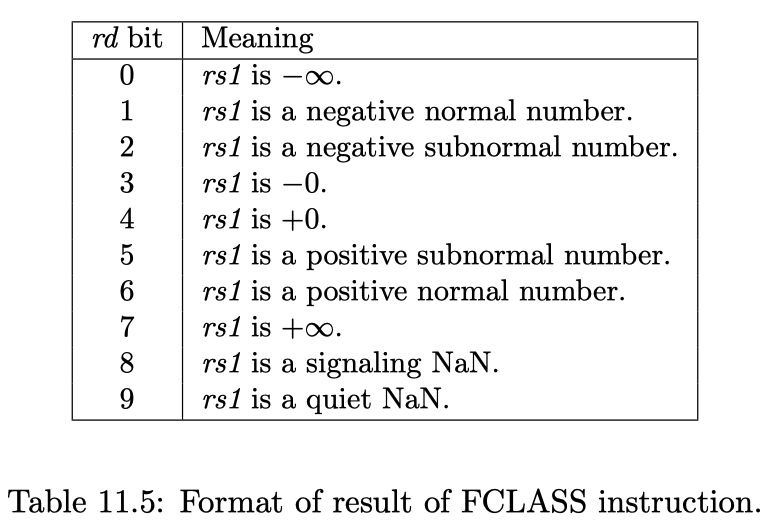
FCLASS
Floating-point / implementations#
Hardware implementation: Berkeley HardFloat#
- Written in Chisel
- https://github.com/ucb-bar/berkeley-hardfloat
Berkeley SoftFloat#
- Conforms to IEEE standard
- Used in SPIKE simulator, and HardFloat’s test suite as golden standard
- http://www.jhauser.us/arithmetic/SoftFloat.html
R32C: compressed instruction extension#
Requirements from the market: code density#
- Code density means less on-chip memory
- Super important for embedded systems
- Higher code density means lower I-Cache miss rate and lower instruction fetch power
16-bit instruction#
32-bit instruction encoding is not very dense, so reduce it to 16-bit
- ARM has Thumb-2
- RISC-V has C-extension
RV32C / how?#
Observations#
- A handful of opcodes are very popular
addi&lw&swconsist more than 50% of the instructions
- GPR access locality: 2/3 of the time are referring to 1/4 of the registers
Ideas#
- Use 16-bit representation of most popular instructions
- Limit register access to only x8-x15 to reduce register index size
RV32C / one big issue#
Comparing to Thumb-2#
- No
ldm(load-multiple) /stm(store-multiple)- Use shared prologue/epilogue. More used, more code saved.
__riscv_save_1:		# shared prologue
addi sp,sp,-16
sw s0,8(sp)
sw ra,12(sp)
jr t0
__riscv_restore_1: 	# shared epilogue
lw s0,8(sp)
lw ra,12(sp)
addi sp,sp,16
ret
function:
jal t0,__riscv_save_1
# ...
jal x0,__riscv_restore_1
Personal experience: not very well supported by GCC compiler
RV32C / result#
Benchmark: SPEC CPU2006#
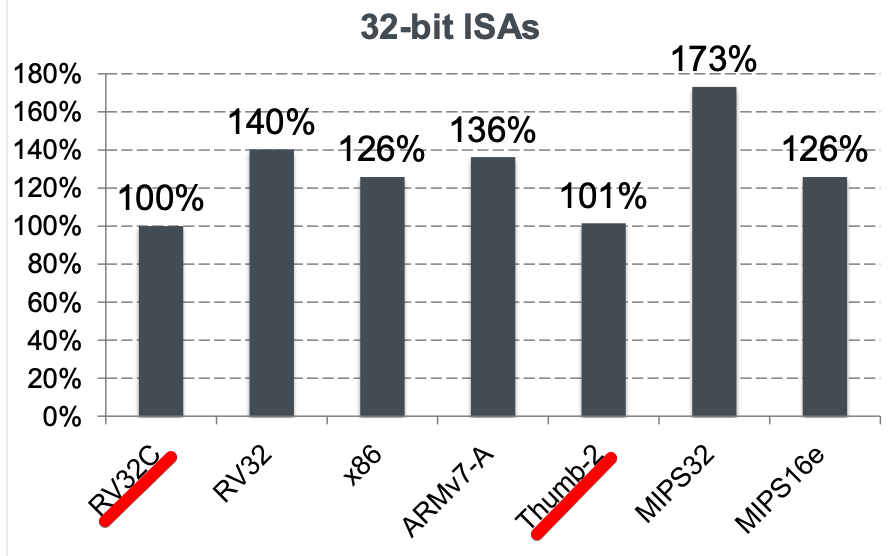
Personal experience: Thumb-2 (ADS) is currently 20% smaller than RV32C (GCC). In the compiler territory, RISC-V still have a long way to improve.
the benchmark should use CoreMark, which is specially design for embedded process use case
Other popular extension#
“V”: vector operations#
- Popular because of AI applications
- Difficult because of compiler
- How to vectorize for loops
- Current solution is LLVM
- Current version 0.7
- https://github.com/riscv/riscv-v-spec
“B”: bit manipulation#
- Useful for specific domains such as communication that need to deal with packed data structures
- Current version 0.0
- https://github.com/riscv/riscv-bitmanip
“P”: packed-SIMD fixed-point operations#
- Parallelize fixed-point operations
- Current version 0.2
Summary#
Extensible#
- Base + extensions
- Custom instruction
- Domain-specific arch
- Still growing fast
Hardware-friendly#
- Simple instruction set
- Designed to make hardware simple
- Micro-architecture freedom
- Compiler still have room to improve
It’s a good time to start learning about RISC-V!#
- Still simple enough to start with
- More committment from big players